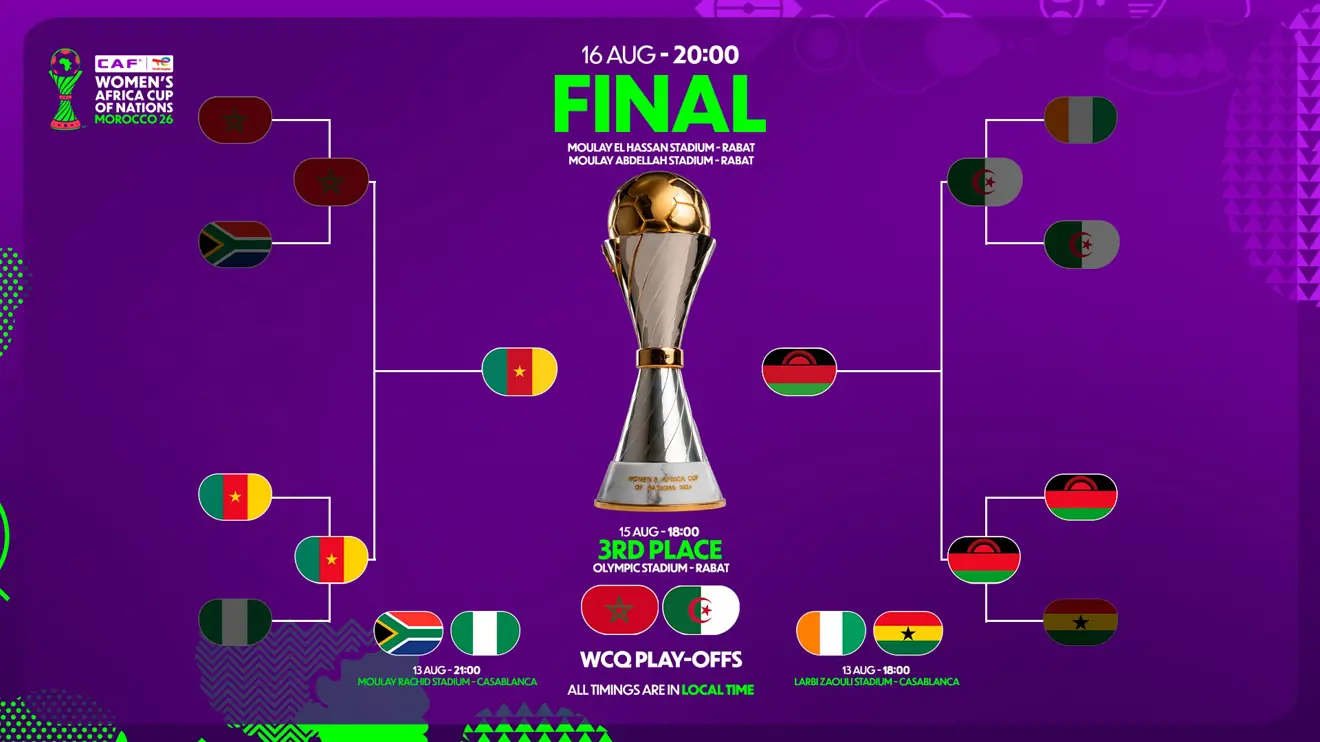
WAFCON 2026 Final Preview: Malawi vs Cameroon
The first 16-team Women’s Africa Cup of Nations will conclude with a final that would have been impossible under the tournament’s original format.
Malawi are competing at WAFCON for the first time. Cameroon did not qualify through the initial process but were invited after CAF expanded the competition from 12 to 16 teams, selecting four additional nations based on the FIFA rankings. One of them will become African champion on Sunday.
Malawi have reached the final by scoring 12 goals in five matches, with Temwa and Tabitha Chawinga contributing nine. Cameroon remain unbeaten and have conceded only twice, eliminating defending champions Nigeria and hosts Morocco without allowing either to score.
Both nations have already qualified for the 2027 FIFA Women’s World Cup. The WAFCON 2026 Final winner in Rabat will now claim a first WAFCON title and receive $2 million in prize money.
WAFCON 2026 Final Details
- Fixture: Malawi vs Cameroon
- Date: Sunday, 16 August 2026
- Kick-off: 19:00 GMT
- Location: Rabat, Morocco
- Stadium: To be confirmed
- Winner’s prize money: $2 million
- Runner-up prize money: $750,000
- Previous WAFCON titles: Malawi 0, Cameroon 0
If the WAFCON 2026 Final is level after 90 minutes, two 15-minute periods of extra time will be played. A penalty shootout will follow if the scores remain level.
How Cameroon Reached a Tournament They Did Not Initially Qualify For
WAFCON 2026 was originally scheduled as a 12-team competition. CAF subsequently expanded the field to 16 and invited Cameroon, Côte d’Ivoire, Mali and Egypt based on their FIFA rankings. None had qualified through the original process.
Cameroon have made the most significant use of that second opportunity. The Indomitable Lionesses won Group D with seven points before defeating ten-time champions Nigeria 1-0 in the quarter-finals. They then survived 120 goalless minutes against Morocco and won the semi-final shootout 3-1.
Their presence in the final is an important part of the story of the expanded competition. Without the format change, Cameroon would not have travelled to Morocco. They are now one match from winning the tournament.
That does not diminish what they have achieved after arriving. Cameroon have eliminated the defending champions and hosts in consecutive knockout rounds, producing two performances built on discipline, defensive concentration and decisive goalkeeping.
Malawi’s Debut Has Become a Title Challenge
Malawi followed a more conventional route into the tournament but have exceeded every expectation since qualifying. They announced themselves with a 3-2 victory over Nigeria, then defeated Egypt 3-1. A loss to Zambia did not prevent them from finishing top of a highly competitive Group C.
The Scorchers beat Ghana 2-1 in the quarter-finals, securing their first Women’s World Cup qualification, before overcoming Algeria 3-1 in the semi-final.
Malawi are no longer progressing because opponents underestimate them. Ghana and Algeria understood the threat posed by the Chawinga sisters and still could not stop them.
Tabitha scored twice against Algeria, while Temwa added the second shortly before half-time. Their individual quality decided the semi-final, but contributions from Faith Chinzimu, Asimenye Simwaka and quarter-final match-winner Rose Kadzere have prevented Malawi’s attack from becoming entirely predictable.
Road to the WAFCON 2026 Final
Malawi
| Stage | Result |
|---|---|
| Group C | Nigeria 2–3 Malawi |
| Group C | Malawi 3–1 Egypt |
| Group C | Malawi 1–2 Zambia |
| Quarter-final | Malawi 2–1 Ghana |
| Semi-final | Algeria 1–3 Malawi |
- Record: Four wins and one defeat
- Goals scored: 12
- Goals conceded: Seven
Cameroon
| Stage | Result |
| Group D | Cameroon 2–1 Mali |
| Group D | Ghana 0–1 Cameroon |
| Group D | Cape Verde 1–1 Cameroon |
| Quarter-final | Cameroon 1–0 Nigeria |
| Semi-final | Morocco 0–0 Cameroon — won 3–1 on penalties |
- Record: Three wins and two draws
- Goals scored: Five
- Goals conceded: Two
The Chawinga Sisters Against Cameroon’s Defence
The final’s defining contest is clear. Malawi have the most productive attack of the two teams, while Cameroon have the superior defensive record. Temwa and Tabitha Chawinga have scored 75 per cent of the Scorchers’ goals between them.
Temwa leads Malawi with five. She scored twice against Nigeria and added goals against Egypt, Ghana and Algeria.
Tabitha has four goals and enters the final after her best performance of the tournament. Her two semi-final finishes demonstrated the range of problems she creates: the first was improvised acrobatically, while the second came after beating her defender and finishing with her left foot.
Cameroon must restrict the space available when Malawi regain possession. Temwa’s pace makes her particularly dangerous during transitions, while Tabitha can protect the ball, overcome direct pressure and create a finish without requiring a perfectly constructed move.
The Indomitable Lionesses have already shown that they can withstand sustained pressure. Nigeria recorded nine shots on target without scoring in the quarter-final. Morocco controlled 64 per cent of possession in the semi-final but managed only three efforts on target across 120 minutes.
Malawi will test that defensive record differently. They attack more directly and are comfortable playing without the majority of possession.
Michaely Bihina Has Already Decided One Semi-Final
Cameroon’s place in the final owes much to Michaely Bihina. Morocco were awarded a penalty in the 118th minute of their semi-final, giving Fatima Tagnaout the opportunity to score what would almost certainly have been the winning goal. Bihina saved it.
The goalkeeper remained decisive in the shootout. Hanane Aït El Haj converted Morocco’s first kick, but Bihina saved the three unsuccessful attempts that followed as Cameroon won 3-1.
Four penalty saves across the closing stages transformed a match Morocco appeared ready to win. Bihina had also played an important role against Nigeria, producing a vital second-half save from Uchenna Kanu as Cameroon protected their 1-0 advantage.
Her challenge in the final will be different. Malawi have demonstrated that they do not require long periods of control to create chances, and their leading forwards are capable of finishing before a defensive structure can reset.
Cameroon Need More Than Another Clean Sheet Plan
Marie Ngah Manga has scored three of Cameroon’s five goals, making her their most important attacking player. She struck twice against Mali and converted the penalty that defeated Ghana. Grace Mendoua and Myriam Maéva Nyadjou are the only other Cameroon goalscorers at this tournament.
Nyadjou’s long-range finish eliminated Nigeria, but Cameroon did not score during 120 minutes against Morocco. Their defence earned the opportunity to reach penalties; Bihina completed the job.
A similar approach may keep the final close, but Malawi have conceded in every match. That record gives Cameroon a reason to attack with greater ambition.
Malawi goalkeeper Sikelo and the defenders in front of her have repeatedly been tested. Algeria recorded nine shots on target in the semi-final, while Ghana scored after only seven minutes in the quarter-final.
The Scorchers have survived because their attack has consistently provided a response. Cameroon must decide whether to target that vulnerability or prioritise denying the Chawingas room at the other end.
First WAFCON Meeting Between the Finalists
Malawi and Cameroon will meet for the first time in women’s international football on Sunday. With no previous head-to-head record, and neither nation having won WAFCON, the final begins without any historical precedent between them.
Cameroon possess far greater experience at this stage. The Indomitable Lionesses are preparing for their fourth WAFCON final and their first since losing to Nigeria in 2016. Malawi had never appeared at the tournament before July.
Experience has not protected the established nations during this edition, however. Nigeria, Ghana, South Africa and Morocco have all been eliminated. Malawi defeated three of those sides, while Cameroon removed the other two finalists from the previous edition.
Record WAFCON Prize Money
CAF doubled the champions’ prize money from $1 million to $2 million ahead of the tournament. It is the second successive edition in which the winner’s payment has increased by 100 per cent, having previously risen from $500,000 to $1 million.
The 2026 runner-up will receive $750,000, a 50 per cent increase, while the total tournament prize fund has grown by 67 per cent from $3.475 million to $5.8 million.
Each of the 16 participating nations also receives $150,000, compared with $125,000 at the previous edition.
The increased investment accompanies the expansion to 16 teams—two decisions that have directly shaped this final.
Three Players Who Could Decide the WAFCON 2026 Final
Temwa Chawinga
Five goals across four different matches demonstrate Temwa’s consistency. Her acceleration during transitions is the most dangerous weapon Cameroon must control.
Tabitha Chawinga
Malawi’s captain enters the final after scoring twice against Algeria. She can create chances through power, close control and improvisation even when space is limited.
Michaely Bihina
Bihina has helped Cameroon keep successive knockout clean sheets and saved four Moroccan penalties during the semi-final. If the final becomes a contest of narrow margins, Cameroon have every reason to trust their goalkeeper.
What Would Victory Mean?
Cameroon were not among the original 12 qualifiers. They can now become the first champions of the expanded WAFCON after using their invitation to eliminate Nigeria and Morocco.
Malawi can complete an even more extraordinary first appearance. They have already become World Cup qualifiers and WAFCON finalists within three weeks of playing their first match at the competition.
The tactical contrast gives the final its uncertainty. Cameroon have allowed two goals in five matches. Malawi have scored 12. The Indomitable Lionesses are comfortable waiting for one decisive moment; the Scorchers have repeatedly created another whenever a match threatened to turn against them.
WAFCON 2026 began by opening its doors to four additional countries. It will end with an invited team facing a debutant for the right to become African champion.
Source: CAF WAFCON 2026 Final
PakarPBN
A Private Blog Network (PBN) is a collection of websites that are controlled by a single individual or organization and used primarily to build backlinks to a “money site” in order to influence its ranking in search engines such as Google. The core idea behind a PBN is based on the importance of backlinks in Google’s ranking algorithm. Since Google views backlinks as signals of authority and trust, some website owners attempt to artificially create these signals through a controlled network of sites.
In a typical PBN setup, the owner acquires expired or aged domains that already have existing authority, backlinks, and history. These domains are rebuilt with new content and hosted separately, often using different IP addresses, hosting providers, themes, and ownership details to make them appear unrelated. Within the content published on these sites, links are strategically placed that point to the main website the owner wants to rank higher. By doing this, the owner attempts to pass link equity (also known as “link juice”) from the PBN sites to the target website.
The purpose of a PBN is to give the impression that the target website is naturally earning links from multiple independent sources. If done effectively, this can temporarily improve keyword rankings, increase organic visibility, and drive more traffic from search results.

Related Posts

Barcelona Optimistic Over Patri Guijarro Renewal
Metro Draw Results