Liverpool Matters – Summer 2025 Squad Analysis & Transfers
Moving on from a club legend
Liverpool probably couldn’t have hoped for a better season. For Arne Slot to come in to replace a club icon in the form of Jurgen Klopp, who left after nine years in charge after reinvigorating the club, alongside FSG, into what became largely his image after Michael Edwards left, and to be successful is remarkable. Especially after having seen other legacy managers leave their clubs and been simply too much for some to follow. To have won the league at the first attempt is incredible.
Yet, at the same time, perhaps it isn’t. Klopp left Liverpool in a far better state than Ferguson had left Manchester United. Liverpool had undertaken a complete rebuild of their midfield in the previous summer transfer window, and all of the signings had proved to be more than able to adapt to life in the Champions League, never mind the Premier League. As such, beyond three, arguably four with Konaté, major contract issues to be resolved one way or the other, this squad was in a position to go again without the need for much alteration.
There was little need for an overhaul because the team that had put together the shortlist for replacing Klopp had been given the time and resources to do their due diligence and come to realise that Slot was the man they wanted. A manager that favoured, if not the same system, then one that the squad could easily adapt to, unlike that of the pragmatic back five preferred by Amorim. Slot, is a by and large calm, confident man, far more unassuming character than his predecessor, and yet he is perhaps just that little bit more of a perfectionist, if such a feat were possible. His tactical acumen may also be better than that of his German counterpart, given Klopp’s deference to Lijnders on tactical matters.
It’s been heavily reported that Slot watched the recordings of training sessions at Liverpool prior to his arrival so that he could pick up details of what they did away from the gaze of public eyes on the football pitch. He used this time to good effect – he learned his new players strengths and weaknesses, but far more importantly, he let them know this and where he expected more from leaders like Salah, as he himself said in a recent interview with Sky Sports. He showed them that he was a winner, not from his actions at Feyenoord in winning the Eredivisie, although I’m sure that helped, but from the way that he prepared for those meetings and setting out what his expectations of his players were.
With limited squad churn, there was instead a focus on what was already working well and tweaking to adapt to the new training methods and playing systems, rather than wholesale changes. Freshening up these areas after nearly a decade under Klopp is no bad thing if you have buy in from the playing staff. Given Liverpool’s long held policy of going beyond the data and undertaking deep character checks to weed out questionable characters before signing someone, this may have had the added benefit of players being open to change. Klopp’s message to the Anfield crowd about getting behind their new manager was also a message to his team too, and I’d be surprised if he did not echo this behind closed doors too. The smoothness of the transition in recruiting the new coaching staff, and the minimisation of disruption within the playing squad helped Liverpool lay the foundations for this success they saw this season.
Squad Analysis
With only Chiesa added to the squad, and Mamardashvili bought and then loaned straight back to Valencia, here’s how the team saw their minutes distributed against their age at the end of the season. Lines either side of the players marker represent their time at the club and time remaining on their existing contract. Homegrown players have yellow markers, and white for those U21 at the start of the season.
The level of playing time given to the squad demonstrates Slot’s reliance on a small, core squad. Whilst there were some minutes for youth and squad players in the Carabao Cup run to the final, these were then limited by early fourth round knock out to Plymouth Argyle in the FA Cup. In truth, Slot still went relatively strong in the Carabao Cup rounds, giving squad players a start rather than youth players, which was the more typical approach of Klopp. He has a set of trusted lieutenants who he knows are drilled in his style of play, but he seemingly felt like he lacked options or depth of quality elsewhere within the squad.
Yet, this graphic also shows an underlying issue that these young players have grown up in a Klopp-orientated approach to playing football, and have done since they joined the academy. Slot’s systems are different to the more high octane style of looking to press and attack instantaneously. Whilst Slot’s teams do still press with intensity, Slot’s side when in possession are more methodical in moments, considered even, and rely upon more nuanced patterns of play between players with specific movements that has required first teamers to move on from Klopp’s approach, for example, the interplay on the right-hand side triangle between, say, Alexander-Arnold, Szoboszlai and Salah.
The fact that Szoboszlai has played more as a 10 then as an 8 is just one example of this and because Klopp rarely played with a 10 after Coutinho left for Barcelona, instead preferring a false 9 in the shape of Firmino, Liverpool don’t have many that are accustomed to playing the 10 role. Players that can do it, yes, but not naturally. This is just one reason why the chance of signing Wirtz must have been attractive to those putting together the shortlist of targets.
Transfers
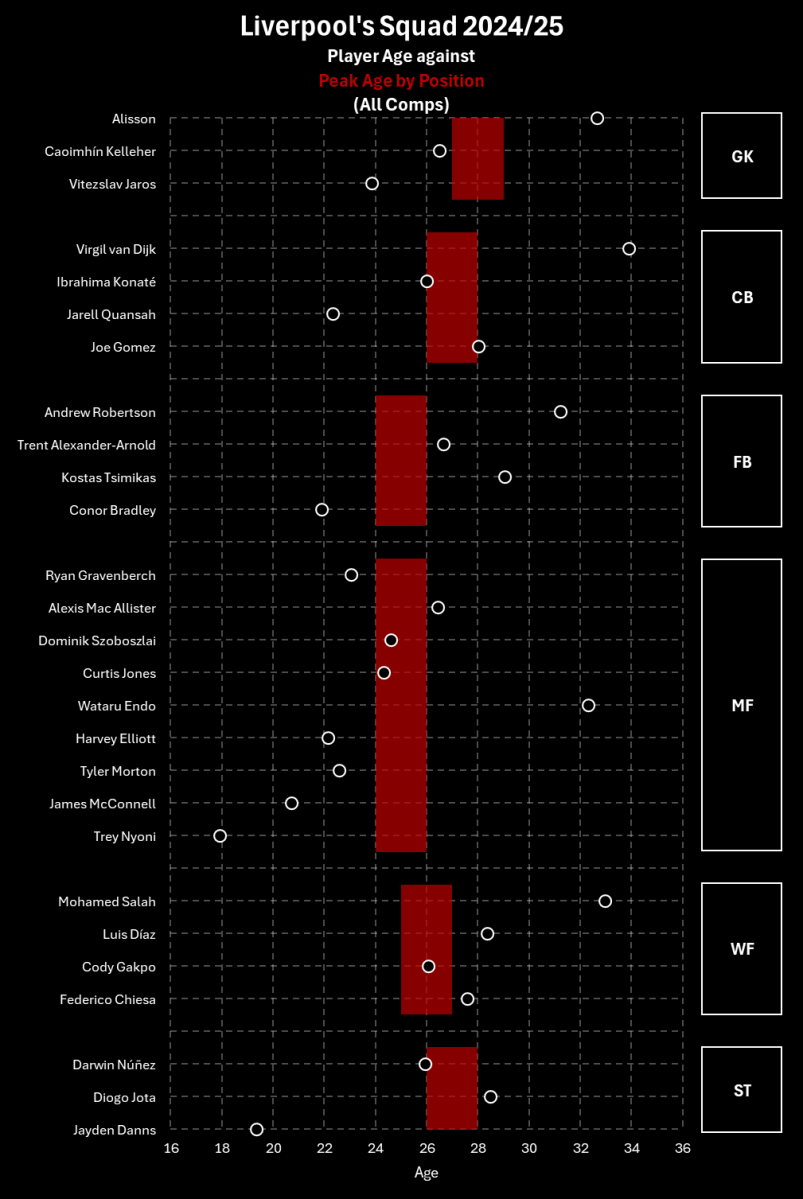
Another is Wirtz’s age. Across all minutes played, Liverpool had a weighted average age of 27.70 across all competitions, but this rises to 27.97 across all Premier League games. Having just turned 22, Wirtz would lower this and still have his peak years ahead of him, according to data collected by The Athletic (see peak player age by position within the read bounds on the graphic below).

With Van Dijk and Salah signing new two year deals, it will be important to refresh the squad by signing younger players to guard against the inevitability of time, whilst learning from their methods and approaches, not just in game situations, but their attention to detail in the gym, training pitches and analysis meetings.
Adding Chiesa to the squad last year actually made the squad older, and whilst the transfer was very low risk given the overall price paid, his lack of initial fitness and the chance to learn the Slot system on the pitch must have played into Slot’s mind about whether or not he could trust Chiesa when it mattered. The fact he played less than 500 minutes across the season tells you the answer, with Chiesa barely used once the Premier League was won.
Whether he stays and solidifies his place in the squad may depend upon what happens with Núñez and Jota. The former is simply too mercurial (read unreliable) and the latter has clearly been impacted heavily by injuries. Chiesa still has time on his contract, and given the lower amortisation value than either of Jota or Núñez, it may be the case that the club would prefer to try to attract buyers for either of these strikers than someone who would have a relatively low resale value. It would not be a surprise to see both Jota and Núñez move on and see Liverpool continue to use Diaz as a false nine, maybe interchanging with Wirtz mid-game if the two can develop an on-pitch chemistry, should the German sign. That said, if both do leave, then the cash raised could be diverted into signing a new out-and-out forward to lead the line. With Newcastle qualifying for Champions League football, and the associated price tag to prize Isak out of St James’s Park, it’s unlikely Liverpool will be able to do both Wirtz and Isak, so there will have to be a cheaper option available in the market should Liverpool move for a new 9 (false or otherwise).
Wirtz’s playmaking abilities are there for all to see when looking at his metrics, especially when you look at his data using a false nine template against positional peers in across the so-called big five leagues, the Champions League and UEFA Europa League. There’s little wonder that Bayer Leverkusen will be striking a hard bargain for his services. He is very clearly an elite player, as evidenced by his FBChart below taken from fbref, and one that could have his best years in front of him at Liverpool.

Liverpool have already had some dealings with the Bayer Leverkusen hierarchy this summer when supposedly triggering Frimpong’s release clause. Bringing in Frimpong to replace Alexander-Arnold is a big indication that Liverpool’s transfer team haven’t tried to replace the, frankly, irreplaceable as these are two not similar right-backs, and may give an early indication that changes have been planned for next season.

As the chart above, also taken from the fbref.com site using the FBCharts extension, Frimpong’s lack of progressive passing indicates the need for a new creative passer, away from the most aggressive and attacking passer the Premier League has seen from this position. This is perhaps why some are so keen to see Crystal Palace’s Wharton join Liverpool as a deep pivot, and was something that was obviously missing until Alexander-Arnold’s introduction in his final league game against the FA Cup winners.
Yet look at Frimpong’s assists per 90 percentile – he still creates shot actions from his progressive carries and these runs from deep can take away some of the weight from Salah, as he starts to slow. Frimpong can commit defenders with his speed and dribbling ability, thus creating space for Salah to operate in more of a free role.
In this area, it’s interesting to note how comparable Frimpong is to Bradley (see comparison chart below). Both prefer to dribble far more than Alexander-Arnold does – but when you have a right foot as gifted as Alexander-Arnold’s, why would you choose to run with the ball? Bradley doesn’t have the top end speed that Frimpong has, but he does have a desire to get forward. He has been notably undercutting into the space opened up by the movement of Salah out wide in the end of season games. If Frimpong can be involved more in the build-up than he has been at Bayer Leverkusen, and adapt to the Premier League, which hopefully he will, with a Dutch manager, backroom staff and three other mainstays of the first team, then he could be a star in the making at 24-years-old.

It may even be the case that once the African Cup of Nations starts that Frimpong could play further up, as evidenced by this season at Bayer Leverkusen. Liverpool have lacked someone who can properly stretch defences since Mané was moved on and Salah lost his initial explosive pace to get beyond a defender.
One critically important point that cannot be overlooked is the fact that Frimpong is classed as home-grown, having developed in Manchester City’s academy before leaving for Celtic. This is important from a squad registration standpoint, not just for the Premier League, but also the Champions League.
In the season just gone, Liverpool didn’t fill their allocation of eight homegrown players when registering their 22-man squad (out of an allowance of 25), and one of the seven that they did register, Hill, permanently left the club in the January transfer window. We known they will lose Alexander-Arnold, and in all likelihood Kelleher too given his desire to be starting goalkeeper and having just one year left on his current contract. Bradley will fill Alexander-Arnold’s slot now that he has turned 22-years-old. Elliott and Quansah will also need to be registered for the forthcoming Premier League and Champions League. None of them took up a registration place in the prior season given that they were all under 21, and, for Champions League registration purposes, did not require registering given that they had been at the club for more than three years.

In signing Frimpong, that puts Liverpool back to the full eight homegrown players required to name a full 25-man squad, although Frimpong would be the only one not to be homegrown at club, but instead, trained in nation. This gives some flexibility if they were to sell Elliott should he wish to leave for first-team football.
If he does, that would mean Gomez, Jones, Jaros and Quansah will fulfil four allocation slots to register a full 25-man squad for the Champions League. This assumes that the latter doesn’t go out on loan to find some more regular playing time, but given the above, I think it’s unlikely he would be permitted to go without further defensive recruitment.

This is also because Liverpool currently only have two unallocated slots for players that are neither homegrown in nation or at club. Adding Mamardsashvili and, perhaps, Wirtz to the squad fills those free slots. Liverpool would have to sell other non-homegrown players in order to bring anyone else in in order to register the new signing. This is critical to any of their transfer plans.
Therefore, for Quansah to leave someone else homegrown at club would have to be deemed good enough to be registered. Perhaps that might be Bajčetić who has been on loan at Las Palmas since January after initially going out to RB Leipzig. Given that Slot is keen for a good passer to play at the base of the midfield given his admission that Gravenberch needs to improve his passing between the lines, there is a (rotation) place in the side for someone who can offer those passes. However, given Bajčetić was in a relegated Las Palmas side that played him in a blend of centre back and defensive midfield, and sometimes only for single halves of games, it’s unlikely he forces his way into the first team on the merits of this year.
Liverpool also have other options that could need to be registered. Ramsay, who has spent some of the season on loan at Kilmarnock, but only played eight games since January. It’s therefore more likely that he would either go out on loan again, or be sold. Others that are possibilities for being sold are Chambers, Phillips (yes, again), Morton and McConnell. Not all will necessarily go, as Liverpool will probably keep one eye on future registration windows, but they’ve been clever with Doak by loaning him to Championship sides so that he can become homegrown in nation whilst earning first-team football away from the club.
Whilst it’s unlikely to be Bajčetić, there will be a need for a ‘new’ 6 to help rotate with Gravenberch given his heavy load this season, but this may instead come from within the current squad.
It’s entirely possible that Mac Allister and/or Jones could be asked to take some of the playing time from him, with Szoboszlai dropping back into the 8 to add more physicality in central areas. He would be freed up from the 10 role given Wirtz’s possible impending arrival.
It’s not out of the question that they try to move Endo on, as he’s appears to be seen as an option from the bench as a ‘finisher’ when Liverpool were looking to close the game out from a winning position, coming on to make hard tackles and committing fouls to slow play down. The fact he didn’t even complete 1,000 minutes over the season is an evident sign that Slot doesn’t wholly trust him and relied on Gravenberch seemingly endlessly, which started to show towards the end of the season, as it did with Szoboszlai given his physical load. That would free up a slot for a non-homegrown player to come in for a player who is already 32 years of age.
When it comes to the goalkeepers, with Kelleher’s exit being touted once more by the media, as Liverpool make his availability clear, Mamardashvili will likely take his place on the bench. Valencia had a disastrous start to the season, languishing towards the bottom of La Liga, and the Georgian only managed to keep eight clean sheets all season for the Spanish side. Despite this, he did record a +0.03 post-shot expected goal – goals allowed statistic, so he performed largely in line with what you would expect of him.

What is evidentially very different is the stylistic play difference between Valencia and Liverpool, although this is somewhat skewed by Alisson refraining from taking goalkicks due to prior hamstring injuries. Nonetheless, it is apparent how different build-up play is at Valencia just from the data, with Valencia seemingly not preferring to build-up from the back. This may be something that Mamardashvili would need to adjust to, and the domestic cups should offer time for this beyond that of the time on the training ground. Hopefully, Alisson can give him some tips on how to improve his save percentage.

The other big issue to address, and one that was mentioned towards the start of this piece, is that of Konaté and the fact he only has one year left on his current deal. The Frenchman has formed a formidable partnership with Van Dijk, and is more than accustomed to covering a right sided full back who has gone forward, so should be well prepared for Frimpong to vacate his right back slot on a regular basis. Contract negotiations with Konaté and his agent were made all the more important when Liverpool lost out on Huijsen to Real Madrid, a player I suspect that they were considering to replace Van Dijk in the long-term. Rumours that Konaté could go the same way as Alexander-Arnold, and leave on a free to Real Madrid would be problematic given Liverpool would be losing a second player without receiving a transfer fee as he goes into his peak years.
Since Gomez has had yet more injury setbacks and Quansah appears to have had a ‘difficult second year’, a new centre back would be required, but one that would be happy to be a rotation option with Konaté to operate alongside Van Dijk before finally taking over from the Liverpool captain. It is perceived better to bring one in now to become accustomed to the system before bedding in another the following year rather than two at once. This is what made Huijsen so appealing: a not unreasonable fee for a young talent who had spent a year in the Premier League showing that he can more than cope with the pace of play having spent the last few in Serie A, and dual footed. No wonder Real Madrid stepped in to turn his head and complete the transfer to seal his registration for next year.
Maybe the club will move for 19-year-old Hato at Ajax, whom it is openly known visited Anfield to watch them beat Ipswich back in January. It may simply be that he is a fan of the club given the level of following Liverpool have in the Netherlands, but he is a player of reputed talent and has already been capped five times for the Dutch national side. There’s little doubt he would be on their radar if a space can be found in the squad and sufficient playing time could be offered to him. Given his young age, he wouldn’t need to be registered for the Premier League, though he would have to be for the Champions League as he wouldn’t have been at the club for three years or more to qualify as an U21 homegrown player.
The other strong rumour doing the rounds in the transfer market is that of Milos Kerkez, the Hungarian left back. Kerkez also fits into the sub-24 age group preference that Liverpool tend stick by, and at 21-years-old already has two years experience in the Premier League. He started every one of Bournemouth’s Premier League games this season, which is a big tick in the ‘availability’ box.

In the event Kerkez joins, Robertson’s playing time would be negatively impacted. With the 31-year-old only having one more year remaining on his contract, there would need to be a decision made as to whether to offer an extension (perhaps unlikely given his drop off in form this year), let his contract run down, or to see if there are any suiters at other clubs who would want a vastly experienced leader in their dressing room. In terms of squad registration, this would effectively be a straight swap, and a ten year reduction in the age of a starting player.
Alternatively, Tsimikas may leave, and there could seem to be a case for this, with Slot putting him in the window towards the end of the season, with the Greek starting in four out of the final seven league games. But that doesn’t solve the issue around what to do with Robertson’s contract. Given Liverpool’s registration concerns, if Kerkez joins, someone else will be required to leave of these two left backs.
There seems to be the usual clammer for Liverpool to build from a place of strength, especially given it’s likely that their rivals Manchester City, who badly need to refresh their midfield, and Arsenal, who look to already be strengthening theirs with the singing of Zubimendi, will be active in the transfer window. Liverpool’s creeping age of the squad in key positions and the relative quiet that we’ve seen in prior windows, this could be the season where Liverpool spend the cash that they have available, as indicated by their failed bids for Caicedo and Lavia back in 2023.
Slot needs players he can trust to more evenly spread the playing time across the squad and play a set of systems that he thinks will win any competition that they are serious about winning. Money should not be an issue, despite the club’s record pre-tax loss in the 2023-24 accounts, as those are looking in the rear view mirror and take into account the lack of Champions League football in that season. Between the prize money for the current season’s Champions League, with an estimated £83.8 million alone from topping the league phase, and the Premier League (a further estimated £181.5m), the club should have sufficient cashflow. This is after taking into account player bonuses and add-ons for prior transfer fees that had clauses tied to the success of the side in the domestic league.
Whatever they do, what is beyond doubt is that they will have used their trusted data analysis team to find their targets before coming up with their shortlists per position, and due diligence will have been undertaken on whoever they look to target from a character trait perspective. That same process has been on-going now for some years, and if you ever want evidence that there needs to be trust in the process, remind yourself of how it felt when you saw Hansen hand the trophy over to Van Dijk for him to lift at the end of this season.
Then consider again that every signing that joined the squad has been through that process, including the manager. If there are players out there are adjudged to strengthen the current squad, in particular given the outgoing of Alexander-Arnold, then I’d like to hope that Edwards, Hughes and their team will do what they can to bring them to the club, because what they’ve done so far, boy has it worked.
Berita Olahraga
Motivation
News
Pendidikan
Pendidikan
Download Anime
Jadwal pertadingan malam ini
Situs berita olahraga khusus sepak bola adalah platform digital yang fokus menyajikan informasi, berita, dan analisis terkait dunia sepak bola. Sering menyajikan liputan mendalam tentang liga-liga utama dunia seperti Liga Inggris, La Liga, Serie A, Bundesliga, dan kompetisi internasional seperti Liga Champions serta Piala Dunia. Anda juga bisa menemukan opini ahli, highlight video, hingga berita terkini mengenai perkembangan dalam sepak bola.

Related Posts
Barcelona Optimistic Over Patri Guijarro Renewal
Metro Draw Results